
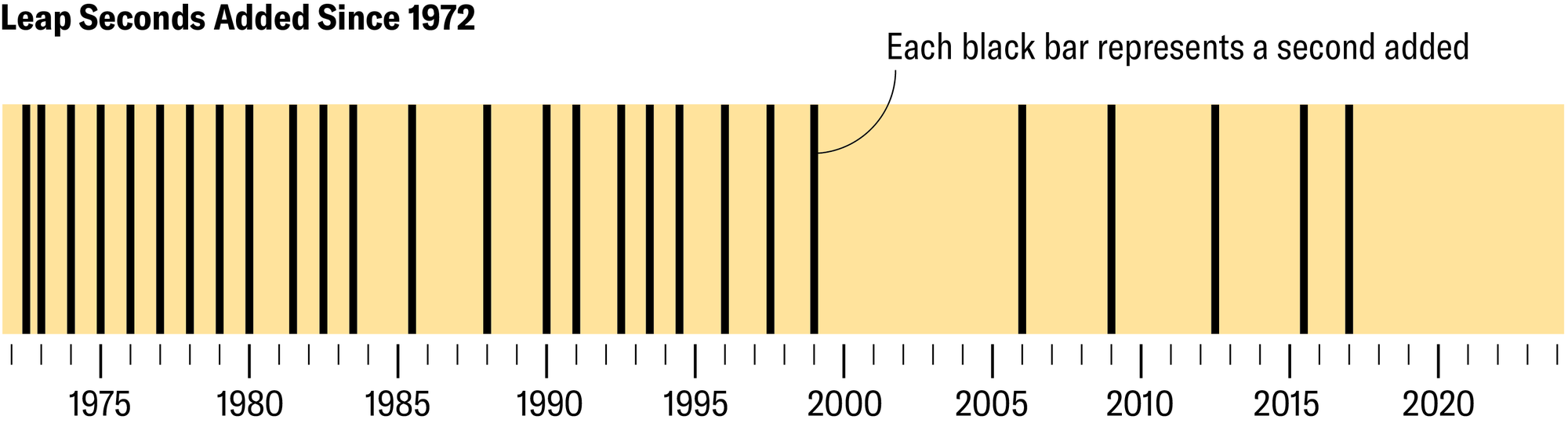
Long ago we humans defined a day as the time it takes Earth to make one rotation about its axis, with one sunrise and one sunset. Our predecessors partitioned that day into 24 hours. But if Earth’s rotation slows down a little, it takes a bit longer than one day to complete it. That has been happening for many years. Because the atomic clocks we use to pace everything from Internet communications to GPS apps to automated stock trades never slow down, global timekeepers periodically have added a leap second to the clocks to keep them in sync with Earth. Since 1972 we have made this awkward addition 27 times.
For the first time, however, we may have to subtract a leap second because since around 1990 Earth’s rotation has been speeding up, counteracting the slowdown and shortening the day. There are two explanations for why, which I’ll explain ... in a second.
The reversal has many people asking why we should bother with leap seconds at all. Each time an adjustment is needed, a mind-boggling number of computers and telecom operations have to be changed. On a regular day, the National Institute of Standards and Technology, which keeps atomic time for the U.S. and synchronizes most of the world’s computers, receives more than 100 billion time-coordination requests from up to a billion computers. And leap-second adjustments can create problems. An addition in 2012 was blamed for Reddit suddenly going dark and for foiling operational systems at Qantas Airways, leading to long flight delays across Australia.
On supporting science journalism
If you're enjoying this article, consider supporting our award-winning journalism by subscribing. By purchasing a subscription you are helping to ensure the future of impactful stories about the discoveries and ideas shaping our world today.
What if we just ignored the fact that Earth’s rotation and atomic clocks are off by a second or even off by one minute, which they are estimated to be a century from now if we do nothing until then? In our highly digitized world, does the exact length of the rotational day even matter?
Earth rotates because our solar system condensed from a rotating cloud of gas and dust. Outer space provides virtually zero drag, so the planets, including Earth, just keep spinning. As Earth turns, the gravitational pull between it and the moon, and to a lesser degree the sun, creates ocean tides. As tides grind across the seafloor, they create friction, which gradually slows the planet’s rotation. Back in the dinosaur era, a day was about 23.5 hours long; since then, tidal friction has extended it.

Matthew Twombly
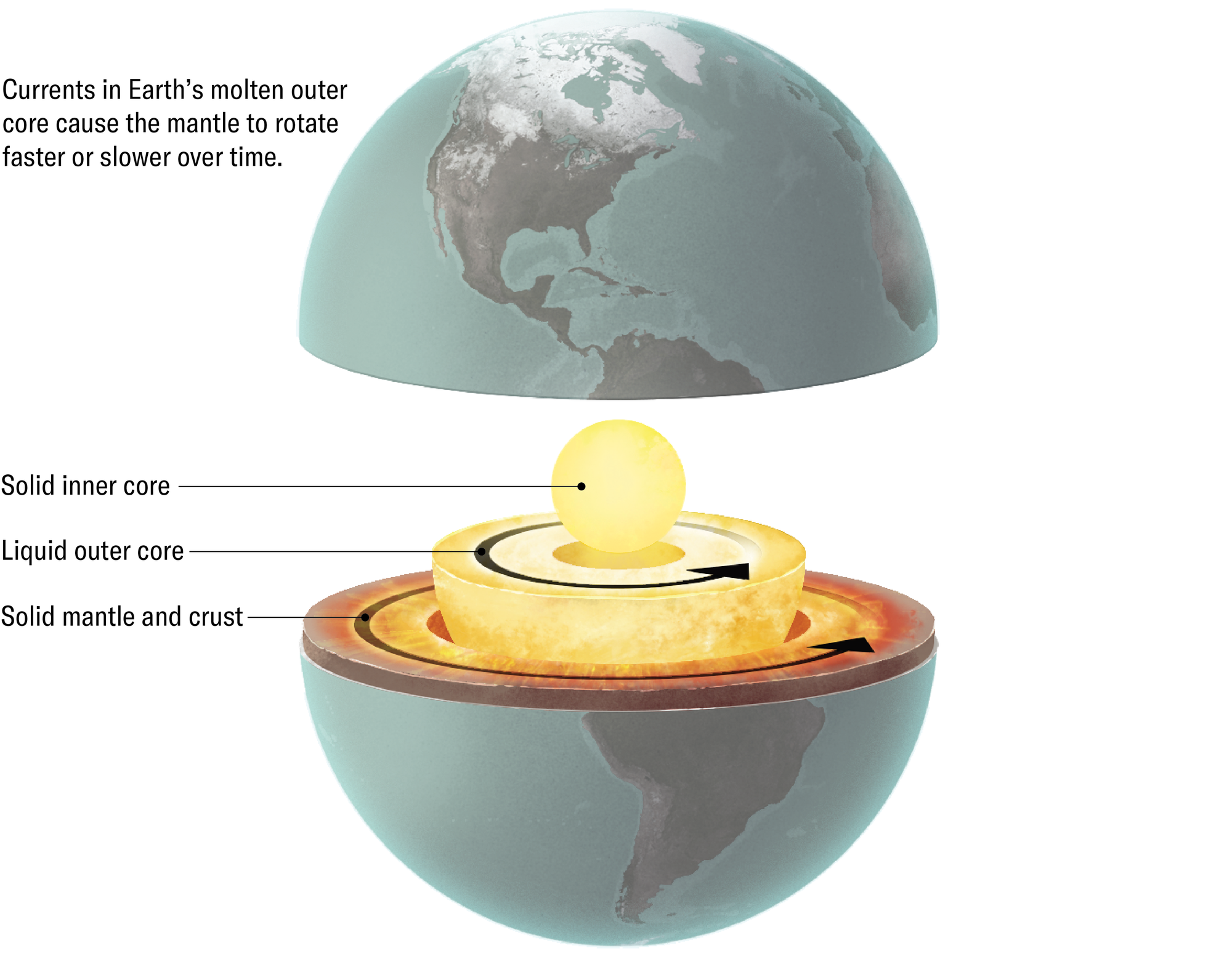
Studies of seismic waves show that Earth has a solid inner core and a liquid outer core, which are wrapped by a solid mantle and crust. Currents in the outer core cause the mantle to rotate faster or slower in any given year, but over centuries the changes tend to cancel out, making tidal slowing the prevailing trend.
Matthew Twombly
Tidal slowing is consistent, but Earth’s rotational speedup has been counteracting that trend, and the time between added leap seconds has been getting longer, from about a year in the 1970s to three or four years in the 2010s.
Jen Christiansen (timeline); Source: Time Service Department, U.S. Naval Observatory (timeline data)
Calculations indicated that by 2026 the ongoing speedup would overtake the slowdown, and we would have to subtract a leap second.
But now global warming is complicating that projection. As the massive ice sheets across the North and South Poles melted at the end of the most recent ice age, the weight of that ice decreased, and the crust that had been compressed underneath it began to rebound, which it is still doing today. That has made Earth more spherical. (The planet is not a perfect sphere; it’s slightly wider around the equator.) The change in shape means Earth’s overall mass is distributed a little closer to its axis of rotation, speeding its movement in the same way that ice skaters spin faster when pulling in their outstretched arms.

Matthew Twombly
As ice sheets warm, however, the meltwater spreads out across the global ocean, and most of the ocean is at lower latitudes, farther from the rotation axis than the ice caps are. That slows the spin (the skaters extending their arms outward). For now this effect is stronger, delaying how soon the rotational speedup will overtake the tidal slowdown. According to a recent study, this counterforce means we won’t have to subtract a leap second until 2029.

Matthew Twombly
Given so many vagaries, it’s reasonable to ask if we should add or subtract leap seconds at all. And because tidal slowing will always be the long-term trend, we may never again need to subtract a second, so why go through the trouble one time? Few computer programs are written to allow for a negative leap second.
Reverence for the rotational day may be the only reason to keep atomic time in sync with it. If the two time stamps diverge, “for most people, there are no real ramifications,” says Duncan Carr Agnew, a geophysicist at the Scripps Institution of Oceanography, who wrote the 2024 Nature paper projecting a negative leap second in 2029. Rather than advocating for frequent and random adjustments of a second, Agnew favors the idea of waiting a century, then making one big adjustment because preparations could be made well ahead of time.
This idea has had support for a while. In 2022 parties to the international General Conference on Weights and Measures voted to stop making leap-second adjustments by 2035. After that, timekeepers might agree to a fix every 20 years or perhaps every 100. Whatever the choice, “we want consistency,” says physicist Elizabeth Donley, chief of the time and frequency division at NIST. “Time is the most important unit in the international system of units; a lot of other standards depend on it.”
Some large Internet providers already follow their own protocols. Rather than waiting for any leaps, Google “smears” its clocks by thousandths of a second once every day. Such independent efforts don’t seem to cause any global discontinuities, but if more and more large entities start winging it, “that becomes anarchy,” Donley says.
Waiting decades for a well-planned adjustment means astronomical (rotational) time, known as UT1, will diverge more widely from the coordinated universal time (UTC) that is based on atomic clocks. But Donley doesn’t think problems will arise. “Computer networks,” she says, “don’t care where the sun is in the sky.”